
From Discovery to an Engineering Material
The Swedish chemist Anders Gustaf Ekeberg first described tantalum in 1802. He named the element after Tantalus from Greek mythology, who stood surrounded by water and fruit but could never reach them. Ekeberg saw a parallel in the tantalum oxide he was studying, which resisted dissolution even in strong acids.
For many years, tantalum was difficult to distinguish from the chemically similar element niobium. It was not until the nineteenth century that the two elements were clearly identified as separate. In 1903, Werner von Bolton succeeded in producing pure, ductile tantalum – an essential prerequisite for the material’s industrial processing.
Resistant under Demanding Conditions
One of tantalum’s most important properties is its exceptional corrosion resistance. A stable oxide layer protects its surface against many highly aggressive media, allowing the material to remain resistant even under demanding chemical and thermal conditions.
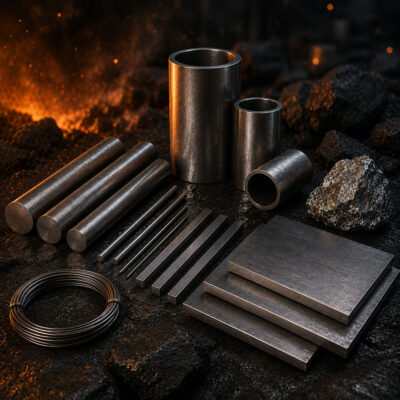
With a melting point of 3,017°C, tantalum is one of the refractory metals. At the same time, it is highly ductile. It can be formed into sheets and tubes, drawn, welded and processed into complex components.
For applications involving higher mechanical loads, tantalum can be alloyed with 2.5% tungsten. This material grade retains the chemical resistance of tantalum while providing greater tensile strength without compromising ductility.

More than Corrosion-Resistant
Tantalum combines chemical resistance, high-temperature performance and good fabricability in a way that few other metallic materials can match. It is therefore more than a means of protecting against corrosion: it is a versatile engineering material for durable and reliable solutions.
As a rare and high-value metal, tantalum is used selectively. Its particular value becomes evident wherever long service life, high operational reliability and stable material properties are essential.
Tantalum in Focus
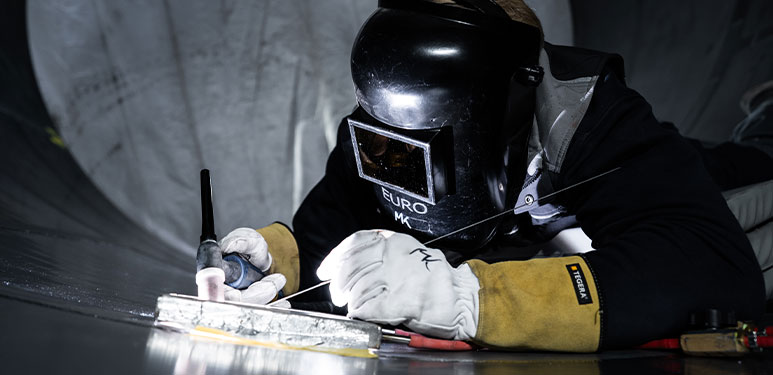
Our engineering and manufacturing operations are entirely dedicated to tantalum. This expertise informs every detail of every component and is built on the day-to-day processing and fabrication of the material.
TAILOR-MADE IN GERMANY
From engineering and every stage of production through to testing and final acceptance, we provide custom-built solutions made in Germany.
CERTIFIED QUALITY
Our quality management system and manufacturing processes comply with internationally recognized codes and standards, including ISO 9001, AD 2000, ISO 3834 and ASME. All current certificates are available here.
READY FOR NEW CHALLENGES
We continuously develop our processes, testing procedures and documentation to meet the additional requirements of regulated and safety-critical industries. Contact us with your specific requirements, and we will work with you to develop the right solution.